
Diced vegetables are everywhere in processed food — frozen mixed vegetables, soups, biryani kits, pizza toppings, salsa and dehydrated vegetable mixes. Cutting cubes by hand is slow and uneven. A vegetable dicing machine produces thousands of identical cubes per minute. This guide explains how dicers work and how to choose one.
Key takeaways
- Dicers first slice, then cut strips, then cross-cut into cubes — in one pass.
- Common cube sizes are 3×3, 5×5, 8×8, 10×10 and 20×20 mm.
- Uniform cubes cook, freeze and dry evenly — the main reason processors use dicers.
How a dicing machine works
In a typical industrial dicer, vegetables are fed into a rotating impeller that throws them against a slicing knife. The slices then pass through a set of circular knives that cut them into strips, and a cross-cutting knife cuts the strips into cubes. Changing the slice thickness and the grid sets the cube size. Remove the cross-cut and the same machine makes strips or French-fry cuts.
Cube sizes and where they are used
| Cube size | Typical uses |
|---|---|
| 3×3 – 5×5 mm | Brunoise for sauces, salsa, dehydrated vegetable mixes, fillings |
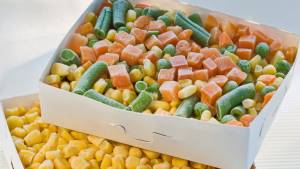
| 8×8 – 10×10 mm | Frozen mixed vegetables, soups, ready meals, biryani kits |
| 15×15 – 20×20 mm | Curries, stews, potato cubes for frying, salads |
Suitable vegetables
Dicers work best on firm produce: potato, carrot, beetroot, radish, turnip, sweet potato, pumpkin, onion and firm fruits such as apple, papaya and mango (at the right ripeness). Very soft or leafy produce is better handled by slicers or shredders.
Capacity
Capacity depends on cube size — smaller cubes mean more cuts and slightly lower throughput. As an example, AFEC’s Turbo Dicer AD-20 handles 400–1,500 kg/h of root vegetables with cut sizes from 3×3 to 20×20 mm, on a single-phase 0.75 kW motor. For mixed slicing, dicing and shredding duties, the ASDS-40 multifunctional cutter offers 10×10 to 20×20 mm dice alongside slices and shreds.
Smaller cubes mean more cuts per kilogram — so a dicer’s output always drops a little as the cube size gets smaller.
Getting clean cubes
- Peel and wash first — a peeling and washing machine keeps the dicer feed clean.
- Keep knives sharp; blunt knives crush rather than cut, causing juice loss and ragged edges.
- Feed evenly; overfeeding causes irregular pieces.
- Chill very soft produce slightly before dicing for cleaner edges.
Engineer’s tip: Remove the cross-cutting knife and the same dicer produces strips — useful for fries, salads and stir-fry mixes.
Where dicers fit in a processing line
In an IQF plant, dicers feed blanchers and tunnel freezers. In a dehydration plant, they feed trays for the heat pump dryer — uniform cubes dry evenly, so one batch doesn’t contain both scorched and moist pieces. In ready-meal kitchens, they feed cookers and kettles.
Frequently asked questions
Can a dicer make French fries?
Yes — without the cross-cutting knife, the dicer produces strips; the strip size is set by the grid.
What is the smallest cube size?
Many industrial dicers go down to about 3×3 mm, used for sauces, salsa and dehydrated mixes.
Can onions be diced in a dicer?
Yes, firm peeled onions dice well; keep knives sharp to limit juice loss.
Related guides
- Potato Peeler vs Brush Peeler: Which Vegetable Peeling Machine Should You Choose?
- Onion Slicing and Cutting Machines for Food Processing and Central Kitchens
- French Fries Cutting Machine and Potato Processing: A Practical Guide
Machines for this job: dicers, slicers, shredders, choppers and peelers from 180 to 4,000 kg/h. Compare vegetable cutting machines →
Why work with Alliance Food Engineering? AFEC supplies vegetable dicers, slicers, shredders, choppers and peelers for kitchens and processing plants, and installs complete wash–peel–cut lines with operator training and spare-blade support. Since 2016 our team has delivered 125+ food processing projects across 20+ Indian states.
Need a dicer for your product?
Share the vegetables, cut sizes and kilograms per hour you need — we will recommend a model and send a quotation.
 Dehydration Line
 CO₂ Extraction
 IQF Freezing
 Ready-to-Eat Retort
 Aseptic Bag-in-Drum
 Fruit Juice Plant
 Mineral Water Plant